

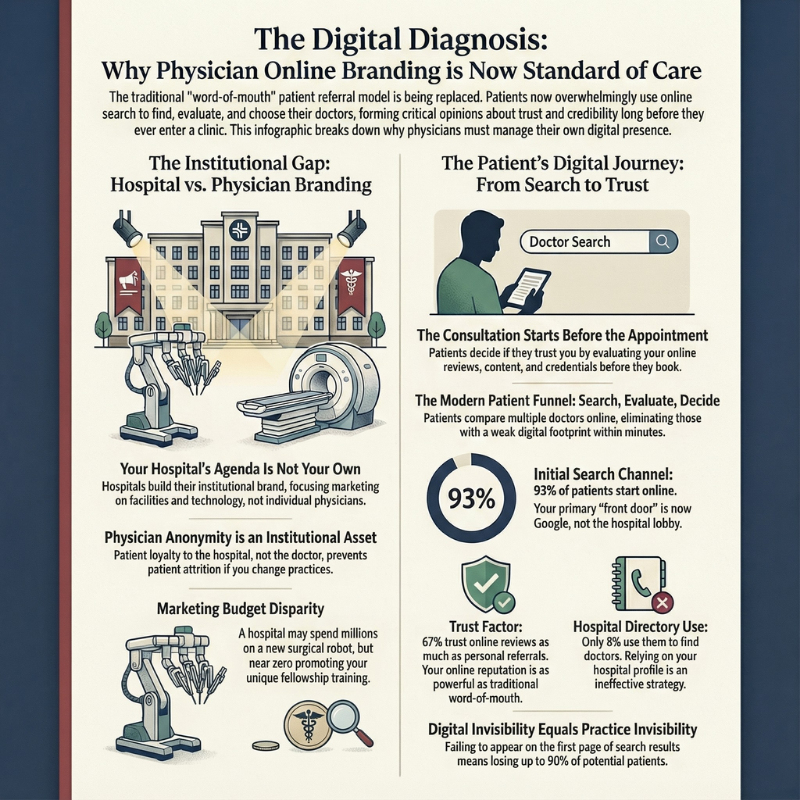
Reality #1: Your Hospital Has Its Own Agenda (And It’s Not Promoting You)
The Uncomfortable Truth:
Walk into any Malaysian private hospital. Look at the marketing materials in the lobby. Check their website homepage. Scroll through their Facebook page.
What do you see?
“Award-Winning Hospital”
“State-of-the-Art Facilities”
“Advanced Medical Technology”
“Leading Healthcare Provider in Malaysia”
Notice what’s missing? Your name. Your expertise. Your unique specialization.
Why Hospitals Won’t Promote Individual Doctors:
I’ll be direct because you need to hear this:
- Hospitals build hospital brands, not doctor brands – Their mandate is institutional reputation, not individual physician visibility
- You’re replaceable in their marketing – If you leave, they’ll promote the next specialist in your chair
- They benefit from doctor anonymity – Patients loyal to the hospital, not you, can’t follow you if you move
- Marketing budgets go to hospital services – New wings, technology, facilities—not individual practitioners
- Doctor directories get minimal traffic – That tiny profile page buried in their website? It’s not driving patients
The Reality Check:
Your hospital spent RM 5,000,000 on a new robot guided surgery and promoted it everywhere. They spent RM 200,000 on facility upgrades and made it headline news.
How much did they spend promoting your 15 years of specialized experience? Your fellowship training overseas? Your exceptional patient outcomes?
Reality #2: If You’re Not Online, You Don’t Exist (Even If You’re Excellent)
The Search That Never Found You:
It’s 11 PM. A young mother’s child has a persistent cough. She’s worried. She grabs her phone and types into Google:
“pediatric Kuala Lumpur”
Fifteen doctors appear. Their Google Business Profiles show:
- Star ratings
- Patient reviews
- Photos of clinics
- Operating hours
- Contact options
- Recent posts about child respiratory health
Your name doesn’t appear.
Not because you’re not qualified. Not because you’re not excellent.
Because you don’t exist in the digital space where patients make decisions.
She books with Dr. Ahmad who has 67 reviews and regular educational posts. You never knew she was looking. She never knew you existed.
The Invisible Expert Problem:
You spent years building expertise:
- Medical degree
- Specialist training
- Fellowship overseas
- Hundreds of successful cases
- Continuous medical education
But none of that matters if patients can’t find you when they’re searching.
The Brutal Statistics:
According to local healthcare search data:
- 93% of patients start their doctor search online
- 82% search on mobile devices (during commutes, at night, during work breaks)
- 72% won’t look past the first page of search results
- Only 8% use hospital directories to find doctors
- 67% trust online reviews as much as personal recommendations
Translation: If you’re not showing up in the first 5-10 Google results for your specialty and location, you’re losing 9 out of 10 potential patients to doctors who ARE visible.
Reality #3: The Consultation Starts Before They Walk Into Your Clinic
The Meeting That Happened Without You:
A patient walks into your clinic for the first time. You introduce yourself. You begin the consultation.
But here’s what you don’t know:
The real consultation started 3 days ago when they searched for you on Google. It continued when they read your reviews. It deepened when they saw (or didn’t see) your educational content. It was influenced by your online presence, your responsiveness, and the digital first impression you made.
By the time they sit in your consultation room, they’ve already decided:
- Whether they trust you
- Whether they’ll follow your recommendations
- Whether they’ll come back
- Whether they’ll refer others
The Pre-Consultation Patient Journey:
Let me walk you through what actually happens before a patient ever books an appointment with you:
Day 1 – 11:47 PM (The Search):
Symptoms are worrying her. She can’t sleep. She grabs her phone.
Google search: “endocrinologist Kuala Lumpur thyroid”
Your profile appears. So do 8 competitors.
She opens 3 profiles in tabs. Yours is one of them.
Day 1 – 11:52 PM (The Evaluation):
Your profile:
- 2 photos (one is blurry)
- 8 reviews from 2 years ago
- No recent posts
- Generic business description
- Operating hours unclear
Competitor A:
- 15 professional photos
- 67 reviews (5 from this month)
- Posted yesterday: “Understanding Thyroid Disorders: What You Need to Know”
- Detailed credentials and fellowship training mentioned
- Clear hours, instant WhatsApp contact
Competitor B:
- 12 photos
- 43 reviews (4.9 stars)
- Weekly educational posts
- Video introduction from the doctor
- Active response to patient questions
She closes your tab. You never knew she was there.
Day 2 – Lunchtime (The Research):
She’s decided between Competitor A and B. She’s reading reviews carefully.
Competitor A – Recent review: “Dr. Nor spent 30 minutes explaining my condition. Very thorough. Managed to get appointment quickly through WhatsApp. Highly recommend.”
Competitor B – Recent review: “Dr. Aizu is very knowledgeable. Explained everything clearly. The clinic is modern and comfortable. Already feeling better after following her advice.”
Both reviews mention clear communication, accessibility, and outcomes.
Day 2 – 2:30 PM (The Decision):
She WhatsApps Competitor A. Gets response in 12 minutes with available slots. Books for tomorrow.
You were never in the running. The consultation happened without you ever knowing a potential patient existed.
Why Pre-Consultation Impressions Matter More Than You Think:
Traditional medicine taught us:
- Patient comes in
- We diagnose
- We treat
- They leave satisfied
- They return or refer
Modern patient journey:
- Patient researches online first (93% of patients)
- Evaluates multiple doctors simultaneously
- Reads reviews and educational content
- Makes trust decision BEFORE booking
- Consultation is validation of pre-formed opinion
By the time they walk into your clinic, they’ve already:
✓ Decided if you’re credible (based on reviews and credentials)
✓ Determined if you’re accessible (based on response times)
✓ Evaluated your communication style (based on content you post)
✓ Compared you to competitors (you probably don’t know who)
✓ Formed expectations about your expertise (fair or not)
The doctor who wins isn’t always the most skilled. It’s the one who built trust before the first appointment.